dossier: Claire Hill of Safeword Theatre for DONORS

Well, it’s been a while. 

The flurry of the end of summer festivals and the prospect of a new space in the city has left me wondering when I’d get time again to devote to this  dossier project. I knew it would naturally come up, and I never had any intentions of letting it fall into obscurity, but sometimes time management kicks in and forces my hand in the direction of those things that require a bit more of my physical presence. What with hub14’s Community Chest residency with Adriana Disman’s LINK & PIN starting up, the hub14 Halloween Party and my theatre band’s first show at Theatre Caravel’s Sea Change (as well as that aforementioned “new space”) I’ve had very little time to search for those exciting new shows cropping up all over the city.

Funny then that the first dossier back is of an artist who’s been quite engrained in the very reasons this project has been on hold. 

I met Claire Hill this past summer at the Fringe Tent in Honest Ed’s Alley. Mutual friend Brandon Crone introduced me to her as basically the second half of Safeword Theatre. Safeword has a history of working with hub14, producing their first play TURTLENECK there, and I’m happy to know they are coming back for their sophomore production DONORS this week! (EDIT: although after reading her answers, it seems I was at the same edition of Monday Night of New Works as she was, because I remember her saying that and remember hearing Brandon’s script…)

I recently had the pleasure of working with Claire directly: ON AND ON (my theatre band) engaged her to design our costumes for our initial performance at the last SEA CHANGE (pictures and more info coming soon!). 

So, without further ado, I am very proud to bring you our first scenographer on the site, dossier #24:

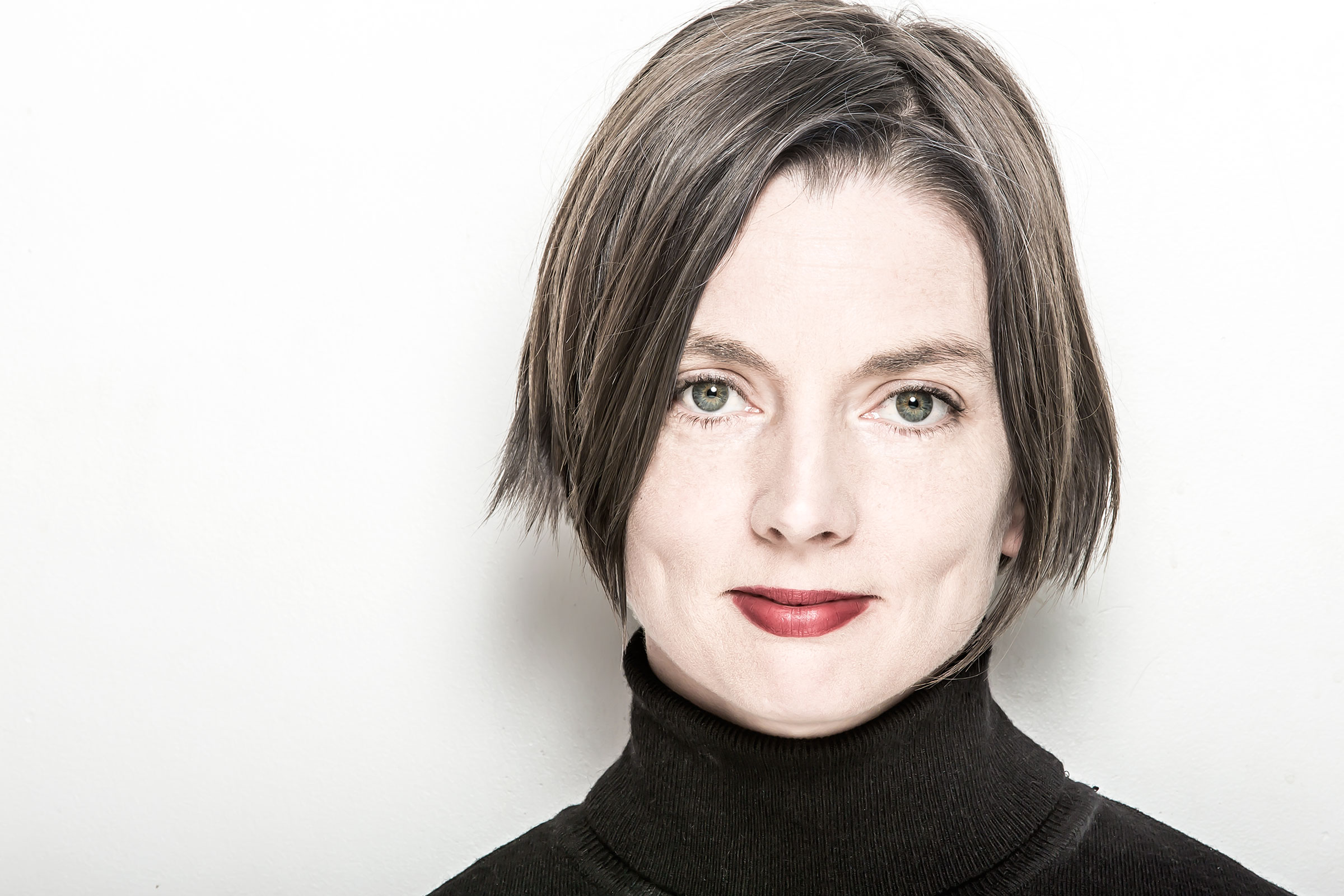
Claire Hill, photo by Chris Cater
Photo by Chris Cater

Who are we talking to?

Claire Hill. Set Designer, scenographer, carpenter, techie, admin monkey.

What gets you going in the morning?

Literally? Coffee and my mother yelling at me to get out of bed. I don’t really believe in mornings and will do anything to avoid being awake for them. In the grander sense of what gets me going, I’d say it’s the desire to work with the people I love. I feel very lucky to be in a community with people who are not only easy to work with but fun to work with.

What is your earliest memory of realizing, yep, this is what I’m going to do with my life?

It comes and goes at different phases of my career. I realized I should be in theatre (just in general) half way through second year of University, while writing an essay about something I hated, probably Wittgenstein, and staring off into the room for about twenty minutes and realizing I needed to switch majors before I died of boredom.

I’ve always been a firm believer that you should try many other things before you commit to a life in theatre, and that it needs to be the thing you must do.

Have there been times you seriously question why you pursue this lifestyle/art form? If so, what was it that keeps you in it, or has brought you back?

Constantly. Design is a difficult career. I started as a technician and learned scenic carpentry so I would know HOW things are built and could interact with technical staff. I had a great time in theatre school but when I graduated and worked professionally I was very frustrated, and I encountered problems I never could have prepared for. After my first year working as a technician I’d had enough, and was very discouraged about the arts in general, so I went back to school and completely relocated and changed everything in my life. Whenever I’ve been discouraged it usually had something to do with the scene of the city I was in, so I’ve moved around a lot and tried different places. I’ve tried a lot of different paths in theatre from techie to admin to design to academic. After I lived out west and only designed a few tiny projects, I came back to Toronto and found a community I really connect with. I love the variety and freedom I have here. This is the first time I feel like I’ve worked with like-minded folk. A professor of mine told me you need to find your tribe, and I think that is a very important element in making a design career work.

Why DONORS?

The obvious answer is that it’s Brandon Crone, who I would pretty much walk over hot coals for. The rest of it is that I love this script, I love the freedom he gives me as a scenographer to create what is best for the play. The trust is really there between us now that we’ve worked together and there’s a strong give and take between us. Very few directors give you absolute freedom to essentially design anything that comes to your mind, but he gives me that.

What kind of atmosphere do you wish to create with DONORS?

Dirty and uneasy. This script makes my skin crawl, and when I first finished reading it I kind of wanted to take a mental bath. I’m a very clean person, very organized and meticulous, so this set is my way of throwing that away and embracing a bit of chaos and a lot of mess. The challenge in design is to create an atmosphere that illustrates the mood of the show but doesn’t foreshadow the events of the play, so it’s a delicate balancing act. Then there’s just the fact that I want to do something people haven’t seen.
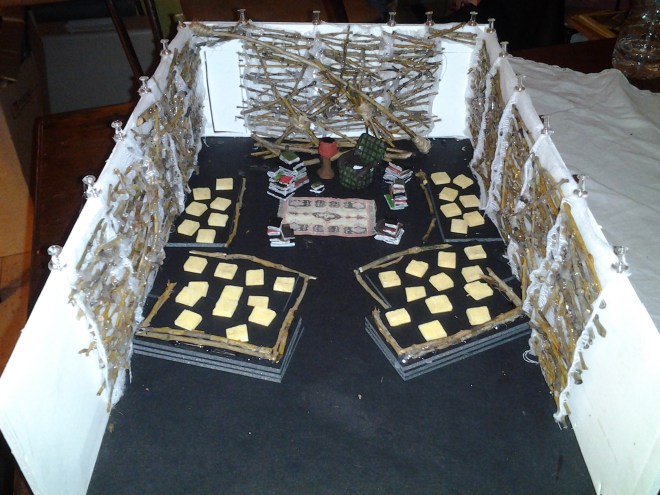
donors maquette
DONORS set maquette by Claire Hill

One of my major goals as a designer is to prove that Indie design can be scenographic, affordable, fresh and of the same caliber as professional design. I am so bored with black stages and ugly risers and flats. I encounter so many people who think that as soon as they make cuts to the budget the first thing that goes is set design- and of course if you’re working with realism the set is going to be the first thing you cut. But if the team is willing to do away with realism there is so much freedom. I have a long list of cheap materials I want to use and am slowly going through it. This time it was twigs and sticks and chicken wire, last time it was clear shower curtains. Fortunately I build what I design, I even have a garage at my parent’s house and a very willing recently retired father who drives me around to get materials. I essentially got this set for free because we sourced it all through people who were throwing things away. Then we built it at home.

turtleneck set
the set of TURTLENECK

How did you and Brandon Crone meet?

I met Brandon through his roommate, Alex Dault (of Single Thread Theatre Company). Three weeks after moving here my good friend took me out to Monday Night of New Works, and we were going around the circle introducing ourselves and I started by saying, “I can build things” and before I knew it Alex literally leaped across the room at me, business card in hand, insisting I get in touch with him. Brandon wasn’t at that edition of Monday Night but Alex was sent with a script from one of Brandon’s plays and when we read it, I was floored. I knew I had to track Brandon down, so I went to another reading the following week at Canadian Stage and basically walked up to him and was like, “I’m Claire. I’m bored. I want to design your sets.” I think that may be the oddest introduction I’ve ever made, but Brandon is the kind of person who rolls with that, so we met a while later about Turtleneck and his warmth and excitement made me really want to be a part of what he does.

Do you have a favourite story so far in regards to working together in the past?

Last winter, while working on Turtleneck, we opened during a snow storm. I had to run to Midoco at Bloor and Bathurst and get some big white sheets of foamcore to cover the windows adequately, so I did that. Of course when I got on the streetcar with two big pieces of foamcore as tall as me and the width of my armspan no one was happy. When I finally fought my way off at Queen I walked down this little alley way to Hub14, and tried to approach the building but was literally blown away. The foamcore was like a sail, and I just started wailing for help. Everyone inside thought I’d slipped on the steps up to the building and broken something, so they were pretty amused when they opened the door and found me struggling against the wind, being blown back about five feet, with these huge pieces of foamcore.

I also made the (slightly regrettable) decision to use the real doors of hub14 to the outside and make Brandon stage things on the fire escape in the middle of February. Basically, I didn’t feel like building a false wall with fake doors, and I’d been living in Victoria for two years and forgotten what a Toronto winter is like. The actors were so amazing about that though, and all of them had to sit in a tiny shed with just a space heater during snow storms and bitterly cold nights. Brandon stood outside for the opening scene of every play and assured people on the street that when our actors were screaming at each other it was just for a play, and not real domestic violence. I think it worked out though, since that was an element of the staging audiences really responded to.

Describe DONORS in three adjectives, a phrase, or with sound.

Donors is a rat in your walls. It chews a hole inside, nests its way through your insulation and your things and your food and keeps you up at night as it crawls around. It makes you angry and grosses you out and sends you off on a murderous rampage, but when you finally encounter the little bastard in the walls, there’s a sad humanity in its eyes that you can’t deny, and you almost feel bad for what you have to do.

Do you have anything else you’d like to share? Photos, videos, links, posters, stories, wishes?

This, obviously.

http://www.safeword.ca/#!productions/cezk

And this, because I think more Scenographers and designers should model themselves off of the fearless Honey Badger.

DONORS Trailer #2:

donors image

dossier: Jess Taylor for The EW Reading Series

Today’s entry in the dossier series sees it branching away from the overwhelming majority of posts focused on theatre creators (you’d think I’m in theatre or something) and brings it into the territory of those artists most people don’t think would get up on stage to perform their art. The EW Reading Series was introduced to me by my then-roommate, and poet, Matthew Walsh as a poetry jam. I showed up, unsure of what to expect. It was my first time attending a poetry jam. I thought everyone would be drinking wine and I’d be expected to snap after each poem. 

This wasn’t the case. And I was surprised to learn it wasn’t just a poetry jam, but a laid-back, party-esque event that celebrated writers of all forms.

What’s funny is that, although it was Matthew who introduced me to this event and to Jess, a few months later Jess independently moved into the same house we lived in (and I still live in). Just a couple floors up.

So, even though one roommate moved away, he, this event and Jess remain relatively, and literally, close to me. 

Enough said.

I’d like you to meet my upstairs neighbour.

dossier #23:

Jess Taylor

Who are we talking to?

I’m Jess Taylor! Hello. I’m a Toronto-based writer and events promoter. I also do art, play music, and teach the youth.

What gets you going in the morning?

I like being busy and keep my life jam-packed. So usually before I open my eyes, I already am thinking about everything I’m going to do that day. I wake up full of anticipation. I make coffee, I hug my cat, and then I get to work. It makes me incredibly happy most of the time.

What is your earliest memory of realizing, yep, I need to write?

I’ve always been a storyteller, but I first started writing things down in grades two and three. I began with poetry, then started writing stories in grade four. Before that, I told stories through pictures and art. I did the usual nerdy writer-kid stuff – like start a poetry club in grade six, start writing weird novels about mice and parallel universes, and made zines in high school. I spent a lot of high school as part of gigging band, The Big Man Himself, but I still saw writing lyrics and the management of the band as contributing to a writing career somehow. I went to high school at Mayfield School of the Arts with a focus in Visual Arts, but I also brought text (either poetry or prose I had written) into my visual work. It all fit together for me.

Why The EW Reading Series?

When I moved to Toronto, I was really shocked by the literary scene here. It was part of the reason I moved. I’d started at U of T for their English in the Field of Creative Writing MA and was automatically included in a community of current students and alumni. I’d been missing that in Burlington, where I’d been living before, and at York University in their undergraduate creative writing program. I wanted to get involved any way I could. My first idea was to use my management and publication background (making zines and working for Existere Magazine at York) to start a micropress for work by emerging writers.

I’ve always believed in running my writing career like how I ran the band: working extremely hard, putting out a lot of content (but content I’m proud of), putting on shows, and – if something isn’t getting done – just doing it myself. So I thought I’d make chapbooks and then sell them at shows to make back the production costs (not really thinking about doing a special “launch” but just running a show every so often). I never got funding for my second year of the MA and was really poor, so getting a press started would be difficult and I gave up on the idea (for the meantime at least).

But I still wanted to do shows. No one knew who I was in Toronto. More accurately, I was a young young emerging emerging writer… I was no one. Nobody was going to ask me to read at their series or even really cared what I was working on. At the time, it seemed that series with curated programming tended to be reserved for more established writers, and younger writers were expected to scope out open mics, stay home and work on their craft instead of seeing performance as part of their craft.

So I decided to start a series. I went and talked to a couple venues. Duffy’s Tavern was really close to my house and was free. I had read there as part of a variety show, and the sound system was decent. I gave myself two months to plan the first show, booking it in January with the first show running March 2012. After that it took off. I now book up months in advance and have a submissions process.

Since I started the series, other series have popped up that feature emerging writers. Some of these series started before my series, but I wasn’t aware of them before I was running mine. I think having so many series in the city really enriches the community. There’s enough crowd to go around, and they are events people want to attend.

I named my series The Emerging Writers Reading Series to make it clear what the series was all about. I call it by its short form “EW” because I think it’s funny. It gets across the sense of play that I look for when curating. I want writers who have a good time writing and will have a good time performing.

What can someone expect when going to EW? What kind of atmosphere do you wish to create?

I found a lot of reading series around the city to be really serious, very quiet. I liked it when I was in the mood for that atmosphere, but I knew for a reading series geared towards emerging writers the atmosphere needed to be different. I drew a lot of inspiration from Pivot, where people could sit with people they didn’t know and make new friends and connections. I wanted to have that sense of inclusiveness, but have even more hype, even more of a raucous environment.

At the beginning, I did this a few ways. I would say hello to everyone who came, introducing myself to people who I hadn’t met before. I would try to introduce people to each other on break and before and after the show. I made a long break between the first half and the second half of the show to encourage people to start conversations. I hosted with a high energy style that tried to show that I cared about each of my readers, that I cared about them as people and as writers, and that I had a great respect for their work, even though they were at the early stages of their careers. The readers and I used to take a shot of tequila either after the show or on break as a bonding experience.

My hosting style has more or less stayed the same, and I think the atmosphere is the same too. The one thing that has changed is that the audience has developed a life of its own. People introduce me to newcomers now. There are too many people for me to introduce myself to everybody, and while there is a steady group of regulars, I get new faces at every show. And a lot of those faces come back. The venue fills up almost completely, so that people have to stand. That already lends a certain excitement to the show, something that no curating or hosting can control. I don’t do readers’ shots anymore because not everyone drinks alcohol and now I often work the next day. I pay my readers and give them two drink tickets. I also become the “drink ticket fairy” and drop drink tickets on unsuspecting members of the audience, convincing them to stay out later at the show’s after party.

The level of quality has stayed consistent as well. The city has a lot of talented and ambitious young writers in it, and I’m always amazed at how good the sets are. I curate each show, but I now have an assistant fiction curator, Sofia Mostaghimi.

What is your favourite memory from a past EW show?

My first show was probably my favourite because it showed me I wasn’t a complete hack; I could really run a series and I could fill a venue and everything would be ok.

Most recently, we ran BIG on Bloor Emerging Writers Past Readers Showcase, and I was thrilled. No one went over their allotted time, people gave great readings, and it was neat seeing EW at a different time (the daytime!!!) and in a different location. It allowed me to dream about it, wondering how big EW might become and what direction I’ll decide to take it.

Describe The EW Reading Series in three adjectives, a phrase, or with sound.

Our slogan: Read! Listen! Have fun!

Do you have anything else you’d like to share? Photos, videos, links, posters, stories, wishes?

Our website: http://www.ewreading.com

My website: http://www.jesstaywriter.com

I blog for The Town Crier about other people’s reading series: http://town-crier.ca

Come check out our first show of the fall season: September 10th, 2013 at Duffy’s Tavern. 8pm, PWYC. Facebook event: https://www.facebook.com/events/221493711333479/229475087202008/?notif_t=like

I have a wish for all of my past readers: never stop writing or reading your work. I book you because I think you’re fantastic, and I can’t wait to see where we all end up as our careers progress.

EW september

dossier: Adam Lazarus for The Art of Building a Bunker / SummerWorks

As SummerWorks gets ready to open, and as the performers are applying the last of their pre-audience polish to their shows, I am trying to figure out my schedule and how to fit everything in. Just like the artists’ minds before opening a show, there is always so much to do and not enough time to do it. 

Luckily, I was able to connect with Adam Lazarus a couple times this year about interviewing him for this site. The first was for The Toronto Festival of Clowns, but, as it goes when you are organizing a festival, time just disappears. Adam then got in contact with me shortly after the festival to do something for his SummerWorks show. I said I’d be more than happy. We gave each other so much time! Almost too much time… I almost forgot about it, this time. 

But! Here we are: a day before the festival, and a dossier for proof. I’m very excited to share this honest and humourous dossier with you today. The first time I saw Adam he was dressed as a recently deceased Vladimir Lenin who took to haunting a soldier stuck in a boxcar of a motionless train on its way to Tyumen. I remember it well. It was definitely one of my top Fringe experiences that year.

Enough said. Here we go, with dossier #22:

summerworks_logo_FINAL

Who are we talking to?

Adam Lazarus. Born and raised in Toronto. Theatre maker, teacher, husband, father. Travelled around, learned some here and there and then started making shows. I love actors and creative thinkers. I love problems and the process of finding possible solutions.

What drew you down this path? (to theatre, to this particular show, to wherever the hell you are in life)

Bunker is born out of a meditation on my difficulty functioning in the world — I’m too sensitive, I’m not always a great communicator, I’m not well read enough, I’m misunderstood, I’m moody, I’m angry, I’m defensive, I’m an egomaniac, I’m an underdog, I’m private. I want a better world and can’t do anything about it. I want my family to be safe. I want to take more naps.

More generally, I wanted to write a show about how people are tricky.

What is your earliest memory of realizing, yep, this is what I’m going to do with my life?

I’ve always been a bit of a masochist with art. I like impossible situations and put pressure on projects to fulfill an impossible artistic desire — to fully fulfill. If a project doesn’t, I change angles for the next venture. What I’m doing with my life is always changing and evolving. I’ve never had an absolute, resolved moment of career realization. I just keep working: I love acting, writing, directing, teaching, studying, producing, gardening, hiking, swimming. I do them all and then some.

Why The Art of Building a Bunker or Paddling the Canoe of Myself Down the River of Inclusivity and Into the Ass of the World?

As a title? Cause it’s funny and you remember it. Or at least remember that it’s the long titled show.

As a show? Cause that’s what we’re all doing right now – we’re building our bunkers, our safe spaces, and happy places. We do it to protect ourselves from, or to function better within, this complicated world we’re living in.

What kind of atmosphere do you intend to set up, or can someone expect when attending BUNKER?

Prepare to enter the mind of Elvis Goldstein. It’s a little noisy in there. And funny and sad and confused.

How did you and Guillermo Verdecchia meet?

I met him outside the theatre a few years ago. We were introduced. We shared a few jokes. A beautiful relationship blossomed.

Have you two ever co-created a show before? If so, what drew you back together? If not, how did this all get started?

This is our first time working together. Guillermo is a deep and intelligent thinker, and a fantastic storyteller. He’s also very funny. Really, it evolved naturally. We got into a room, started improvising, and now we’re premiering the workshop presentation of our play 8 months later.

What is your favourite memory from a past Summerworks experience?

In 2011, Susanna Hood’s Shudder. I love her work. That, and winning the Spotlight award for my bouffon show Wonderland…

Describe BUNKER in three adjectives, a phrase, or with sound.

AAAAAHHHHH!!!! WAAAHHHH!!!! HAHAHAHA!

Do you have anything else you’d like to share? Photos, videos, links, posters, stories, wishes?

Early on in rehearsals, Guillermo and I listened to this terrifying and mesmerizing woman rant about the world for 20 mintues. As Guillermo puts it, she became our spirit guide as we ventured along the rivers of our bile and toward the shores of our spleens.

http://youtu.be/wLoqti0lzAw

Here’s the poster of the show (click on the image to be taken to its SummerWorks profile):

bunker poster copy

dossier: Heidi Strauss, Kate Alton and Luke Garwood for “for me?” / Summerworks

Heidi Strauss, another of the past ADs of hub14, has been instrumental in helping us get up on our feet and making sure we are headed in the right direction. Her care for detail and efficiency is quite motivating. I’ve never seen her work before, so am definitely looking forward to catching this original, site-specific Summerworks show.  I’ve also never met Kate Alton or Luke Garwood, but if Heidi was commissioned to choreograph / direct this piece, I’m sure the dynamic created between the three artists will be an experience worth seeing at Summerworks.

I’m grateful all three of them decided to participate in this dossier, so without any further ado from me, as this is a super-sized post, we’ll get right into it.

dossier # 20:

kate alton and luke garwood heidi Strauss

Who are we talking to?

Heidi Strauss, Kate Alton and Luke Garwood.

What drew you down this path? (to dance, to wherever the hell you are in life)

Heidi: Many people are probably responsible for where I am and what I’ve learned to this point. But the bottom line is that I love dancing, the simple act of moving and the possibility of what it can do to move people, to transform.

Kate: I was always drawn to dance. As a child there was never any question in my mind about what I wanted to do. It has always felt like part of me. It feels particularly good to be doing it now, with one of my favourite choreographers, a fabulous partner and after a hiatus from performing while I stayed home with my young twins.

Luke: Mostly street signs. oh…the figurative path? The figuratively gravel laden, dusty, dance path? Well I started because I saw it on TV and thought it might be fun to do. I was about 10. I enjoyed it so much I haven’t looked back at a map or gps (trying to stay in theme) since.

What is your earliest memory of realizing, yep, this is what I’m going to do with my life?

Heidi: Going haywire on a ballroom floor when I was 2 at a wedding reception. I was wearing a violet dress with purple flowers that I called a dirndl, even though it wasn’t (my mom bought it at JCPenny). But seriously, it’s a question I keep asking: is this what I want to be doing? So I am not continuing out of habit – that it’s a decision — because some days it’s a hard decision.

Kate: I don’t remember ever thinking anything else.

Luke: There was no ‘one’ moment but rather a culmination of experiences. I have trained for the goal of becoming a professional dancer since the age of 11. So I was pretty set early on, but it was through the teachers I was lucky enough to work with, encountering fellow students/colleagues who shared the passion, and the performance opportunities I was able to gain, that truly made me want to commit “my life” to the art form.

Why “for me?” ?

Heidi: ‘for me?’ because it is a commission made think very much about Kate who asked me, and about the nature of what developed in the first process with she and Luke a few years back. I often think a duet is able to translate so much so clearly about behaviour, about why we react certain ways, why we do certain things for each other, and why we don’t. The commission also came about at a particular time when I was/am asking a lot of questions about whom we are doing all this for, what is performance? On a personal level these questions relate to acts of generosity in life, and professionally (though a distinction between personal and professional is often blurry) through work we make and perform. In the latter part of the process the question ‘for me?’ became one the three of us asked about our city – which will be evident when (if) you see the show.

The sweet answer, however, is that there is stage when a toddler is growing up and given things, from a glass of water to a new toy, when they ask with disbelieving delight: ‘for me?’ I think, as adults, we do this too — but silently and particularly when we are taken by surprise, or something we are given has a special kind of weight.

Kate: Really a question for Heidi, but one sense of it is the exploration of who a performance is actually for. Is it for the performer, the creator, the audience, and what are our respective roles in those relationships? What does it mean to give and to receive, in the context of performance and beyond? What are the gifts that are given to us by our ancestors, the gifts of our personal history?

Luke: My interpretation is that it’s a play on the give and take that happens in a theatrical performance. We’re trying to create a piece for an audience to enjoy while actively pursuing our own artistic and aesthetic goals, which could generate the question: who is this performance for? I think Heidi hits a rare balance with her work by creating pieces a wide-ranging audience can truly enjoy while still being artistically relevant and challenging. As far as I can tell “for me?” is actually for all of us.

What kind of atmosphere do you intend to set up, or will someone experience while attending “for me?”

Heidi: One where the weather co-operates, the audience is welcomed and feels comfortable.

Luke: We unfortunately have little control over our atmosphere and seeing as our piece takes place outside it’s especially disconcerting. We have all doubled up our efforts to recycle and reduce our green house emissions so that the atmosphere maintains it’s healthy-ish state of protectiveness. Fingers crossed.

Have you worked with each other before? How did this specific collaboration begin, and, if applicable, how did the very first collaboration between you begin?

Heidi: I danced with Kate Alton in a work of Laurence Lemieux’s shortly after I finished school and then again in stage and film work of Michael Downing/dancefront. Later on I danced in a number of her works when her company Crooked Figure Dances was Overall Dance. Those works included Tartan Briefs and Great Leap Forward. She is one of my mother’s favourite dancers. This is the first time I have worked with Luke, although while I was a co-director of hub14 we commissioned him to create something for Full Stop, and Luke and I are working on and off on a gallery project with Jenn Goodwin. It has been a real pleasure, and honour to develop something with these very generous folks.

Kate: The three of us have never worked together before. I have worked with Luke both as a fellow dancer at Coleman Lemieux & Compagnie, and also as rehearsal director there. I think the first time Heidi and I worked together was on a solo I did for her way, way back for Series 8:08. So long ago I don’t know what year it was! I have never worked for Heidi as a dancer before but she has been involved in two of my projects. I have been admiring her work for years.

Luke: I had worked with Kate at CLC and Heidi and I had done a collaborative project together but I had never worked on a piece like this with either of them, so I was more than eager to come on board.

What is your favourite memory from working on “for me?”

Heidi: Being unable to continue working because of uncontrollable laughter, speaking in double negatives, rehearsing in a baseball diamond when we were double booked in the Lower Ossington rehearsal space.

Kate: Off the top of my head I would say it was the last run-through we did, the first full run-through onsite. I had a sense of the whole work coming together and it was very satisfying. We laughed a lot in the process, worked hard and I rediscovered the dancer in my body, so lots of good things.

Luke: There was a day of gift giving where we ended up sharing more than just material gifts, we gave each other our stories, memories and histories, and that was pretty special.

Describe “for me?” in three adjectives, a phrase, or with sound.

Heidi: What we do is what we do.

Kate: Colour, Connection, Conversation. Not adjectives, but those are what come to mind.

Luke: ohhhhhooooooooooo (that’s a sound)

Do you have anything else you’d like to share? Photos, videos, links, posters, stories, wishes?

Luke: I wish you’d all come see the show and let us know what you think.

for me poster