Last year, my friend Nicole Ratjen asked me to do a staged reading with her at an event I’d never heard of. It was of her play, a work-in-progress about two polar bears set adrift on an ever-shrinking ice-floe in the middle of the ocean. As the polar bears contemplated their fate, and hunger, they would be ravaged by storms. We’d done this reading before, at a different event, and were curious how it would go over at this one.
This is when I met Eric and Julia. We asked if Eric would be interested in reading our stage directions. Of course. Nicole told him about the audience participation, that he was to cue the storms and the audience would be involved with making it come alive. No problem. And this is where the real test came in; Are you both cool with us arming the audience with pin-pong balls that they can throw at us when you cue the storm? Not even a hesitation. Eric even helped by throwing the ping-pong balls back into the audience to restock them. That’s the kind of event SEA CHANGE is. And that’s the spirit that Eric and Julia bring to this; they are so excited to see artists try new things and for their nights to be as varied and unique as possible.
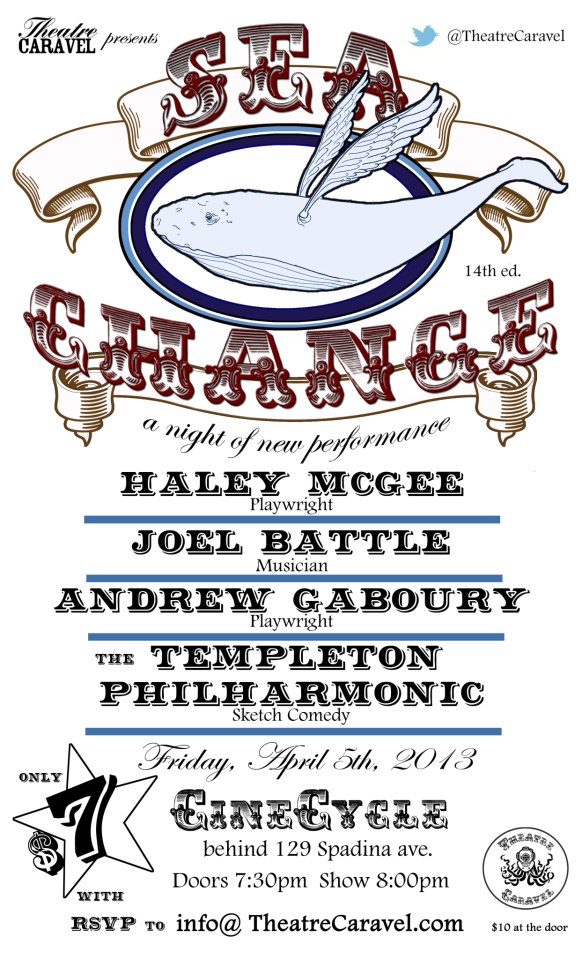
I’m excited to have this next dossier focus on such a fun event. The next SEA CHANGE is happening on April 5th, and, along with Haylee McGee, Joel Battle, The Templeton Philharmonic and Freddie Rivas, I’ll be performing some new writing of mine.
Here we go, dossier #10:
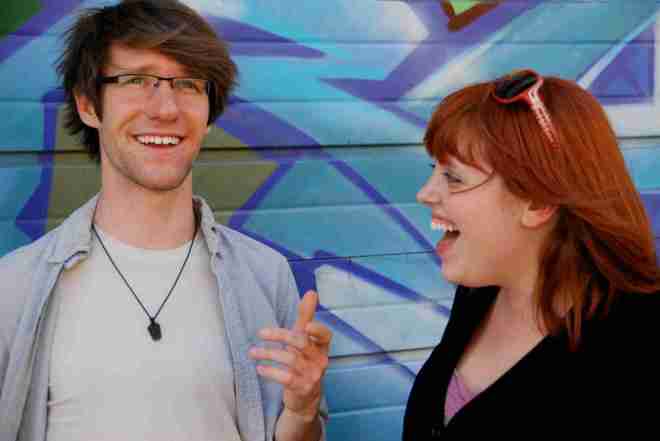
Who are we talking with?
Eric Double, Artistic Director of Theatre Caravel. I am an actor, director, and mask maker.
Julia Nish-Lapidus, Artistic Producer of Theatre Caravel. I’m an actor and producer.
Theatre Caravel strives to create theatre that is changeable, innovative by necessity, and important by default.
What is it about theatre that really gets you going?
Eric: I think I was drawn to the theatre because it’s such an immediate art form. When a piece of theatre works there is a palpable energy around the performance and it becomes otherworldly in a sense. I love that feeling of connection between an audience and a performance, which is both personally intimate and communal at the same time.
Julia: Theatre is alive. That’s always really excited me. It’s never the same twice, so the actors and the audience in that room are the only people who will be able to share that specific experience.
How did you two meet?
Eric: We met through university, but became friends because we were neighbours in our residence. Julia had a mouse problem and was afraid to clean the traps, so she asked me to come over and clean up dead mice. I meet all my best friends cleaning up dead animals.
Julia: It’s true. Dead mice are gross. After university we talked over (a few) drinks and realized that we were both looking for similar experiences and challenges and decided to join forces and bring our voice to the theatre community.
What is the earliest memory you have of wanting, or needing to do this?
Eric: Well, according to my mother I was quoted as saying “I want to be a clown because I want to make everyone laugh” when I was 4, but my actual memory comes from high school. I remember getting hooked on performing when I landed a part in the play in high school and since then there was never any question about what I would be doing. It wasn’t really a need or a want, just a feeling that nothing else was important to me other than being involved in theatre – I never felt more at home than when I was in or involved in the theatre.
Julia: What inspired me to get into theatre is not exactly what people expect, considering the type of work I now do… It was CATS, the musical. When I was four, the touring production came to Halifax (where I was living) and I saw commercials on TV with singing and dancing cats, and I begged my parents to take me for my birthday. What four year old girl wouldn’t? Barely halfway through the show, I turned to my mom and whispered “I want to do that.” And I meant it. The next day I hassled my parents until I was signed up for every dance, voice, and acting class we could find. And I haven’t stopped since then. It was never something I thought about. Being in theatre was just the way life was for me.
Why Sea Change?
Sea Change is a phrase that means “a profound or notable transformation” and was coined by Shakespeare in the Tempest. Our event is about encouraging new works from artists of all types and creating a community around that. It gives artists a chance to experiment and try something different in a really unique mix of like minded people and the audience gets a chance to be a part of a fresh new artistic landscape that is unfolding right in front of their eyes.
What kinds of things can we expect from Sea Change?
Sea Change is a curated event and we’re always accepting submissions from all different types of artists. We’ve had poets, playwrights, puppeteers, and painters; musicians, mask makers, clowns, storytellers and more. We’ve also had a bunch of artists who want to try something different than what they normally practice. So, for example, it’s always a great joy to us when an actor wants to put up their visual art, or when a playwright wants to try out some poetry. Providing a community for artists to push their boundaries is really what Sea Change is about.
Also, there are free baked goods. And we’re talking home-baked yumminess. People come for the art, but stay for the brownies.
What is your favourite memory from a past Sea Change?
Eric: Probably Teodoro Dragonieri performing in masks made from cut-up laundry detergent bottles. I remember the audience didn’t see it coming and he had everyone on the edge of their seats trying to figure out how he brought inanimate objects to life.
Julia: There was one time when a performer needed a bit of extra time to set up, so he told a joke while he was getting ready, but then he still needed more time, so the whole crowd got into it. Eric and I told bad jokes and audience members just kept yelling out more jokes. The performer was ready to go after only a couple of jokes, but everyone was having so much fun, we kept going for a while. That’s what Sea Change is like. It’s not rehearsed and the audience is a part of it. It’s a great community feel and that’s what I love the most.
Describe Sea Change in three adjectives or a phrase.
Supa-fresh – electric – baked goods
Do you have anything you want to share with us? A story? A photo? A song? A video?
Our first Sea Change took place in a very small cafe space, where people were crammed in on top of one another. It was raining that night and everyone was dripping wet. The thunder and lightning cracked just as we were getting started and one of our performers, David Calderisi, let us know that in some eastern traditions thunder is a omen for great creativity and we can remember feeling like there was a certain electricity and excitement in the air. That thunder really set the tone for that night, and three years later we still think about it before every new edition of Sea Change gets started.




 a field of crowns