dossier: Adriana Disman for LINK & PIN

Working with hub14 over the last year has really broadened my horizons in regards to what types of performance, and what types of performers are on my map. With this partnership, my map of the world has finally been updated from one of those old maps where North America is somehow connected to Russia to a slightly newer one where all the continents have more or less their true outline but there are still things like giant serpents in the sea and the four winds controlling the air.

While exploring these new, defined worlds, I’ve had the distinct pleasure of working alongside Adriana Disman, a passionate, caring and ambitious creator who I really want to describe as fiery, but if I do you’d have to imagine the cool blue flame that keeps burning on after all that crazy orange has had its time. 

I digress. 

Let’s just get on with the interview.

dossier #27:

Adriana

Who are we talking to?

Adriana Disman: I’m a performance art maker, thinker, and curator based between Toronto and Montreal. I’m currently curating a performance art series at hub 14 entitled LINK & PIN as well as completing my M.A. in Theatre and Performance Studies at York University.

What gets you going in the morning?

A foolish optimism.

And right now: Anne Michael’s writing, a particular video recording of Glenn Gould playing Bach’s Goldberg Variations, and Dolly Parton’s 9 to 5.

What is your earliest memory of realizing, yep, this is what I’m going to do with my life?

God, I think I have that realization everyday. One moment, each day, when time stops and all I hear is my heartbeat and I think, “Oh. So this is what life is for me.”

Have there been times you seriously question why you pursue this lifestyle/art form? If so, what was it that kept you in it, or brought you back?

Absolutely. I originally trained and worked professionally as an actor for many years before growing unhappy with my path. When I found performance art, I essentially had to choose to leave a world I had worked very hard to learn. A profound leap, for me. And one that required taking ownership of my craft — to trust my way of doing things. And an absolutely freeing one. Now, even when I occasionally agree to do a theatre piece, I carve out space to make the work in my own way. Maybe that’s just part of aging as an artist.

What was the inspiration for creating LINK & PIN?

The inspiration for L&P grew out of a series of house shows that I curated in Toronto called A Home for Performance in 2011. The events took place in my Grandmother’s house (thank god for grandmothers who love performance art!) and were borne out of a desire to open space for people whose work I loved and wanted to see.

Eventually the shows got too big for Gram’s house.

So when hub 14 awarded me the Community Chest to put on a series, I was thinking a lot about the sense of community that sprung up around Home. Part of that was from having shows in the afternoon, which allowed for a different kind of attention to bring to the work. And, since it wasn’t 11pm when the performances finished, people would hang out and talk about the pieces afterward, meet each other. I watched beautiful friendships and collaborations spring out of these talks.

Why LINK & PIN?

In thinking about the name for the series, I was questioning how to articulate an intention to create community, to forge links between people, without falling into an idealistic unicorns-and-rainbows-lets-all-hold-hands-and-love-each-other. I mean, I love unicorns as much as the next person but I don’t take community building lightly. I think community building is sticky- it so easily becomes exclusionary and snooty.

Link-and-pin is actually a coupling technique that was used to connect train cars. Links protruded from each end of the cars and would be brought together so that an employee would drop a big “pin” through both, connecting them. However, it was actually exceptionally dangerous- apparently, many folks lost fingers or were even crushed between the cars. Yeeesh.

This, for me, is a perfect example of community building: usually simple until unexpectedly violent.

Tell us a little about the last two LINK & PIN instalments  Were there loose themes that determined who was involved, or did the themes come about after you looked at the rosters?

The first event, FEMINIST FIBRES, actually grew out of the work of Helene Vosters and Thea Fitz-James, two artist whom I love and whose work I saw a strong affinity between. From there, I invited Joce Tremblay and Maryam Taghavi, proposing the theme for them to create in response to, because I thought they would bring wonderfully different viewpoints to the event.

PARTICIPATION on the other hand, was theme-first. Most of my own performance works have been participatory and I have huge ethical questions about the genre. As an audience member, participatory works have been both some of the most transformative and some of the most violating works I’ve experienced. So I invited contributors whom I thought would have an interesting take/ response to the theme. It’s worth mentioning that two of the artists were actually crowd-sourced: I sent out a message on facebook asking, “Who is your favourite Toronto- or Montreal-based participatory performance artist?” I researched everyone who was suggested and then invited two artists from the resulting list!

I keep stretching the way that artists are given space to perform within the series because I believe that some curatorial methodologies prioritize certain kinds of artists / people. It’s a small gesture but one that I hope begins the large task of opening the series to more and more different kinds of artists.

Who are some of the artists involved this time around?

Oh baby. It’s gonna be good. For REPERFORMANCE, Victoria Stanton is coming in from Montreal to present the second iteration of a durational work that was shown at VIVA! this year. Also on Saturday, Feb 8th: hollyt and Jack Bride are presenting a very exciting piece inspired by Breyer P-Orridge. On Sunday, Feb. 9th, Julie Lassonde is reperforming a persona from Margaret Dragu (who’s also in town that weekend performing with WIA projects!), Brianna MacLellan is presenting a work by Julie Radul, Shannon Cochrane is presenting a top-secret piece, and Paulina Wiszowata is inviting the public to reperform Vita Acconci’s Following Piece with her!

Basically, I’m swooning.

And I want to mention that all of this has been made possible by the help of my fantastic intern, Veronia Abrenica.

Describe LINK & PIN in three adjectives, a phrase, or with sound.

LETS TRY IT!

Do you have anything else you’d like to share? Photos, videos, links, posters, stories, wishes?

Yes! Actually, you are in luck because it just so happens that we’ve JUST released L&P’s online platform for REPERFORMANCE. Our first video addition to the series by Lee Henderson and Bee Pallomina is, essentially, spectacular. I love this work so much that I literally start squealing and get all wiggly when I read the description.

So now, for your viewing pleasure, from The Marina Abramovic Institute Department of Puppets presents Relation in Time:

“The Marina Abramovic Institute Department of Puppets is pleased to launch Seven Easy Puppet Pieces, a collaboration by its first graduating class of students and their research into performance, video, duration, and the limits of the puppetbody.

Relation in Time references the absence and presence of a bodily audience, and the gradual loss of connection between puppets. Beginning with its premiere as part of the LINK&PIN online platform, we at the MAIDP are remounting seven historical works of performance by Marina Abramovic and Ulay. In so doing, we are bold enough to demonstrate what has long been suspected by the performance community worldwide–that we are all, now, Marina’s puppets.”

You can check out documentation from past events and read about future ones on LINK & PIN’s website. You can also check out Adriana’s performance work and curatorial practice here!
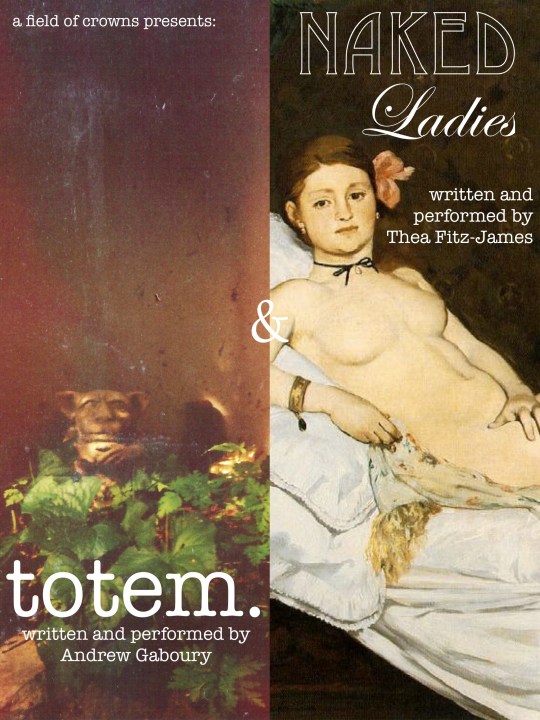
proudly presenting:

nakedtotemfinal

a field of crowns presents:

A DOUBLE-BILL!

totem.

by Andrew Gaboury

&

NAKED LADIES

by Thea Fitz-James

If you missed totem. in Hamilton, now’s your chance to catch it in Toronto!

Together, Fitz-James and Gaboury bring you a night of honesty, ritual, mythology, story, bias, nakedness and drinking.

totem. is an exploration of one man’s emotional, mental landscape as he confronts his crumbling relationship and is presented with a fantastic manifestation of his ideals. While a work of fiction, totem. was born from months riddled with a crisis of self-confidence. At the end of this time, Gaboury realised what he needed wasn’t what he always relied on, and instead found relief in something completely unexpected. totem. began life as a short story, mostly written by stream-of-conscious, influenced by the performance of spoken-word poetry.

NAKED LADIES is that moment where someone tells you that women are naturally secretive. It’s the moment they say, “Women take off their clothes to forget about their fathers”. It’s locked in the skin; intimate—between the shadow and the soul. For what are we hiding when we show it all? And what does it mean to be truly exposed? Between the naked and the nude, between forgetting fathers and remembering mothers, past sexual stigma and personal secrets, NAKED LADIES weaves personal narrative, art history, and performance theory to ask why women get naked on stage and off. Why, where and for whom?

WARNING: This show contains mature and explicit content.

When?

Dec. 13th & 14th
@ 7pm & 9pm

Where?

hub14, 14 Markham St., Toronto, ON

How much?

$15 general / $10 arts worker & student

tickets are available at the door
-or-
can be reserved online by sending an email to:
afieldofcrowns@gmail.com

dossier: Marie France Forcier of Forcier Stage Works for IN absentia

Slowly but surely, it seems, I’m getting to all of the current and past ADs of hub14. The amount my hub colleagues work is astounding to me, and I feel like I can never keep up with their ability to constantly produce. At least, in terms of this project. I’m happy about what my dossiers can do, but sometimes they feel inadequate as I keep wanting to promote the amazing work folks like Heidi Strauss, Cathy Gordon and Kate Nankervis are doing. This project, however, would get overrun with the same names too quickly, and that’s definitely not the direction I want to take this. I want each dossier to be unique.

I am lucky to be working closely behind the scenes at hub14 with Marie France Forcier. She radiates a maternal energy, one that is always in control and capable of steering the ship safely through the storm. She helps bring stability to what can otherwise easily turn into chaos, and the amount of trust she has in others is admirable. I can only imagine what it’s like to work with her creatively.

Enough gushing, on to dossier #25:

Marie France Forcier

Who are we talking to?

Marie France Forcier, artistic director of Forcier Stage Works (forcierstageworks.com) and MFA candidate in Dance at York University; co-artistic director at Hub 14. Montreal-born and raised, Toronto-based for the last decade. Graduate of The School of Toronto Dance Theatre’s professional training program, performer, writer, pedagogue, road warrior but most predominantly choreographer ever since. Academically researching the expression of trauma and dissociative states in contemporary choreography.

What gets you going in the morning?

Since I started my grad studies while keeping up my professional life? The sheer fear of not being able to stay on top of an ever growing pile of work! …In all seriousness: the excitement I feel about my work and my research.

What is your earliest memory of realizing, yep, this is what I’m going to do with my life?

I was in my first of a three year as a double major in Psych and Dance at CEGEP de St-Laurent in Montreal. I noticed that the director of the dance department and senior dance majors were addressing me with the assumption that I was planning on a career in dance.

I’d always vaguely dreamt of it as I was growing up, without ever allowing myself to believe that I had the chops. Finding out that others thought that my going in that direction was plausible allowed me to get there myself.

Have there been times you seriously question why you pursue this lifestyle/art form? If so, what was it that keeps you in it, or has brought you back?

I never question why I do. The drive is always very present although it constantly renews and redefines itself. There certainly are times when the hardships that come with a career in the live arts seem to outweigh the benefits, but those dips never make disconnect with the impetus.

Why IN absentia?

Three choreographic projects make up my MFA’s practical component: an autobiographic solo in studio theatre, an ensemble work for the proscenium stage and a self-produced dance event including the candidate’s choreography off campus. IN absentia is my off campus production. My choreographic contribution to the program is entitled Levity as IN (absentia); it is a short duet, it explores the experience of dissociative states in the presence of the other, revealing the dissonance that creates for the viewer.

My piece being less than 15 minutes long, and since I had Hub 14 for the event at my disposal, I figured: why not create a mixed program, providing an opportunity for other artists to present new work in a casual setting? Lucy Rupert (Blue Ceiling dance) and Brandy Leary (Anandam) are prolific creators, whom I admire and have know through collaborations on various projects. Heather Berry-MacPhail has been a pillar in my work since Forcier Stage Works’ inception.

Half Second Echo is an emerging collective of recent York dance graduates. Offering them a spot addresses my personal mandate to create opportunities for the emergence wherever I can.

In the year that followed my own graduation years ago, I was blessed with opportunities that kept me active and persevering in a competitive world. I am very grateful to those who provided me with such opportunities; the first year often determines the course of a career; whether the young person will persevere in the arts or abandon. I believe that returning the favor is a good way to make the dance community sustainable, on a micro-level.

Anandam_2013_021
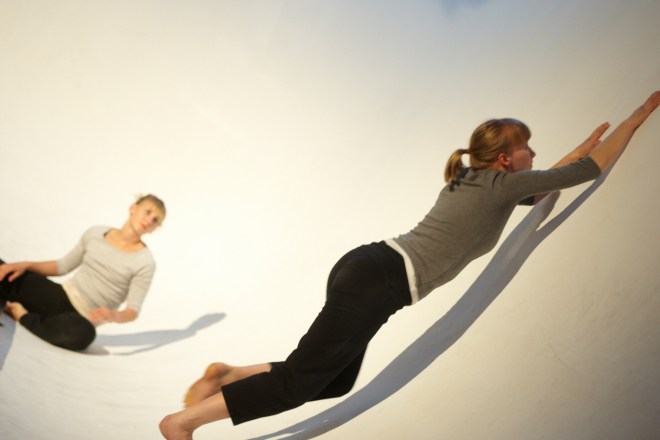
Dancers Heather Berry-MacPhail, Justine Comfort (photo credit: Walter Lai)

What kind of atmosphere do you wish to create with IN absentia?

With Levity as IN (absentia), I am creating an atmosphere where coping mechanisms keep the characters standing. Where “retreating within following an episode of trauma” becomes the new normal. Where they have to share physical space with one other, externally present, internally elsewhere, trapped in a snapshot that may never be successfully processed; in absentia.

The other pieces on the program will bring their own atmospheres.

IMG_0201
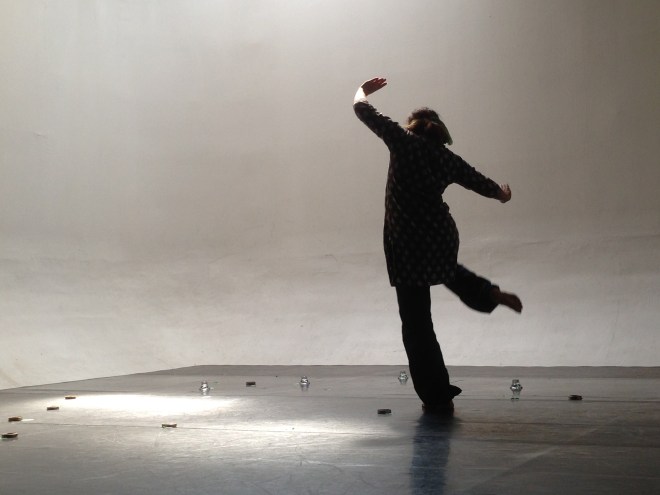
Brandy Leary in process for IN absentia

This is part of your MFA thesis work with York University. Did you ever think your work would bring you to IN absentia?

It has been a gradual process. The awareness that my own history of trauma had been seeping through the symbolism in my choreographic work arose within me over the course of 2 years or so, in phases. This insight about my own work led to my decision to dedicate my MFA research to the expression of post-traumatic stress in choreography. The process for Levity as IN (absentia) is a part of that.

What’s your favourite story about working on this project?

Levity as IN (absentia) is a work that has been in progress for nine months now, re-adapted twice for presentation over the course of that period. The most recent one was presented at Collective Space in Toronto, where the walls are curved, and the two dancers were climbing, reaching for unattainable levity, and sliding off walls as a choreographic feature. It was fun to watch, playful despite the contrasting content.

Describe IN absentia in three adjectives, a phrase, or with sound.

An assignment adapted for the better into a community event.

Do you have anything else you’d like to share? Photos, videos, links, posters, stories, wishes?

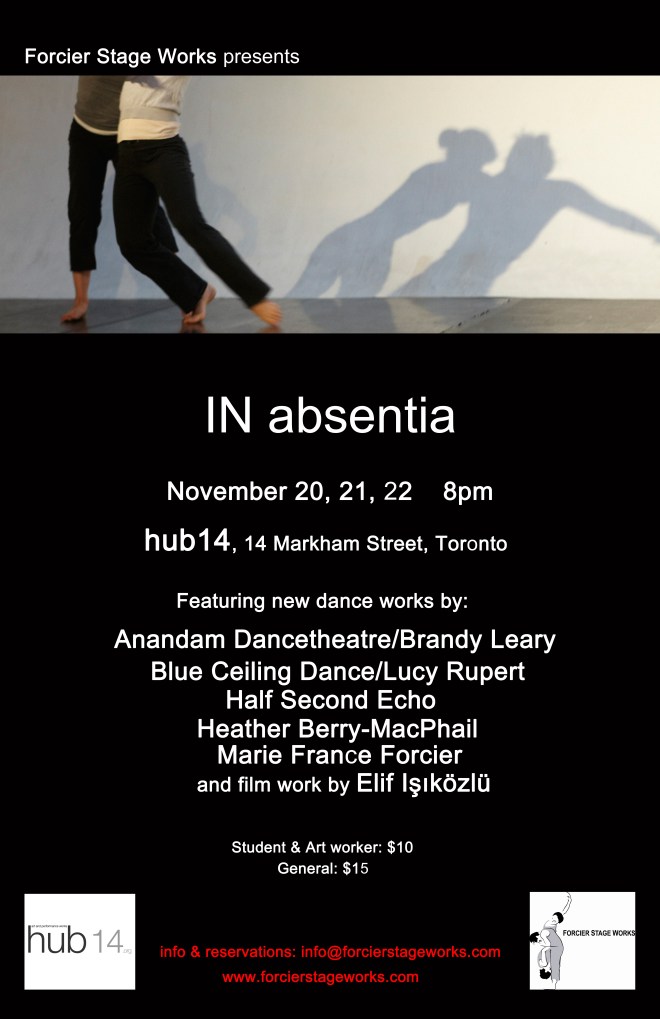
FSW_IN-absentia

dossier: Claire Hill of Safeword Theatre for DONORS

Well, it’s been a while. 

The flurry of the end of summer festivals and the prospect of a new space in the city has left me wondering when I’d get time again to devote to this  dossier project. I knew it would naturally come up, and I never had any intentions of letting it fall into obscurity, but sometimes time management kicks in and forces my hand in the direction of those things that require a bit more of my physical presence. What with hub14’s Community Chest residency with Adriana Disman’s LINK & PIN starting up, the hub14 Halloween Party and my theatre band’s first show at Theatre Caravel’s Sea Change (as well as that aforementioned “new space”) I’ve had very little time to search for those exciting new shows cropping up all over the city.

Funny then that the first dossier back is of an artist who’s been quite engrained in the very reasons this project has been on hold. 

I met Claire Hill this past summer at the Fringe Tent in Honest Ed’s Alley. Mutual friend Brandon Crone introduced me to her as basically the second half of Safeword Theatre. Safeword has a history of working with hub14, producing their first play TURTLENECK there, and I’m happy to know they are coming back for their sophomore production DONORS this week! (EDIT: although after reading her answers, it seems I was at the same edition of Monday Night of New Works as she was, because I remember her saying that and remember hearing Brandon’s script…)

I recently had the pleasure of working with Claire directly: ON AND ON (my theatre band) engaged her to design our costumes for our initial performance at the last SEA CHANGE (pictures and more info coming soon!). 

So, without further ado, I am very proud to bring you our first scenographer on the site, dossier #24:

Claire Hill, photo by Chris Cater
Photo by Chris Cater

Who are we talking to?

Claire Hill. Set Designer, scenographer, carpenter, techie, admin monkey.

What gets you going in the morning?

Literally? Coffee and my mother yelling at me to get out of bed. I don’t really believe in mornings and will do anything to avoid being awake for them. In the grander sense of what gets me going, I’d say it’s the desire to work with the people I love. I feel very lucky to be in a community with people who are not only easy to work with but fun to work with.

What is your earliest memory of realizing, yep, this is what I’m going to do with my life?

It comes and goes at different phases of my career. I realized I should be in theatre (just in general) half way through second year of University, while writing an essay about something I hated, probably Wittgenstein, and staring off into the room for about twenty minutes and realizing I needed to switch majors before I died of boredom.

I’ve always been a firm believer that you should try many other things before you commit to a life in theatre, and that it needs to be the thing you must do.

Have there been times you seriously question why you pursue this lifestyle/art form? If so, what was it that keeps you in it, or has brought you back?

Constantly. Design is a difficult career. I started as a technician and learned scenic carpentry so I would know HOW things are built and could interact with technical staff. I had a great time in theatre school but when I graduated and worked professionally I was very frustrated, and I encountered problems I never could have prepared for. After my first year working as a technician I’d had enough, and was very discouraged about the arts in general, so I went back to school and completely relocated and changed everything in my life. Whenever I’ve been discouraged it usually had something to do with the scene of the city I was in, so I’ve moved around a lot and tried different places. I’ve tried a lot of different paths in theatre from techie to admin to design to academic. After I lived out west and only designed a few tiny projects, I came back to Toronto and found a community I really connect with. I love the variety and freedom I have here. This is the first time I feel like I’ve worked with like-minded folk. A professor of mine told me you need to find your tribe, and I think that is a very important element in making a design career work.

Why DONORS?

The obvious answer is that it’s Brandon Crone, who I would pretty much walk over hot coals for. The rest of it is that I love this script, I love the freedom he gives me as a scenographer to create what is best for the play. The trust is really there between us now that we’ve worked together and there’s a strong give and take between us. Very few directors give you absolute freedom to essentially design anything that comes to your mind, but he gives me that.

What kind of atmosphere do you wish to create with DONORS?

Dirty and uneasy. This script makes my skin crawl, and when I first finished reading it I kind of wanted to take a mental bath. I’m a very clean person, very organized and meticulous, so this set is my way of throwing that away and embracing a bit of chaos and a lot of mess. The challenge in design is to create an atmosphere that illustrates the mood of the show but doesn’t foreshadow the events of the play, so it’s a delicate balancing act. Then there’s just the fact that I want to do something people haven’t seen.

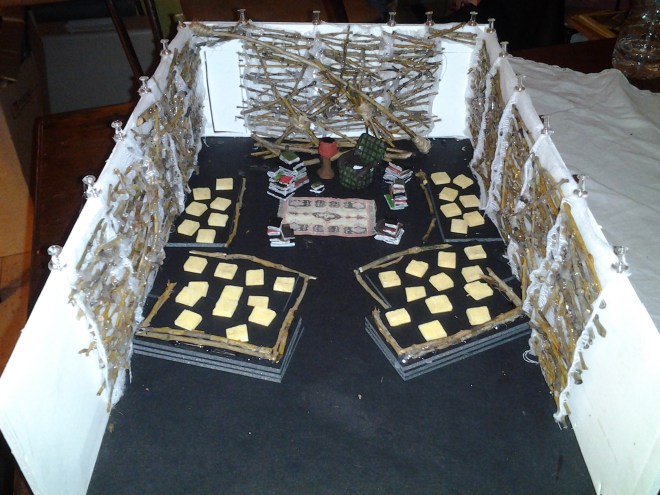
donors maquette
DONORS set maquette by Claire Hill

One of my major goals as a designer is to prove that Indie design can be scenographic, affordable, fresh and of the same caliber as professional design. I am so bored with black stages and ugly risers and flats. I encounter so many people who think that as soon as they make cuts to the budget the first thing that goes is set design- and of course if you’re working with realism the set is going to be the first thing you cut. But if the team is willing to do away with realism there is so much freedom. I have a long list of cheap materials I want to use and am slowly going through it. This time it was twigs and sticks and chicken wire, last time it was clear shower curtains. Fortunately I build what I design, I even have a garage at my parent’s house and a very willing recently retired father who drives me around to get materials. I essentially got this set for free because we sourced it all through people who were throwing things away. Then we built it at home.

turtleneck set
the set of TURTLENECK

How did you and Brandon Crone meet?

I met Brandon through his roommate, Alex Dault (of Single Thread Theatre Company). Three weeks after moving here my good friend took me out to Monday Night of New Works, and we were going around the circle introducing ourselves and I started by saying, “I can build things” and before I knew it Alex literally leaped across the room at me, business card in hand, insisting I get in touch with him. Brandon wasn’t at that edition of Monday Night but Alex was sent with a script from one of Brandon’s plays and when we read it, I was floored. I knew I had to track Brandon down, so I went to another reading the following week at Canadian Stage and basically walked up to him and was like, “I’m Claire. I’m bored. I want to design your sets.” I think that may be the oddest introduction I’ve ever made, but Brandon is the kind of person who rolls with that, so we met a while later about Turtleneck and his warmth and excitement made me really want to be a part of what he does.

Do you have a favourite story so far in regards to working together in the past?

Last winter, while working on Turtleneck, we opened during a snow storm. I had to run to Midoco at Bloor and Bathurst and get some big white sheets of foamcore to cover the windows adequately, so I did that. Of course when I got on the streetcar with two big pieces of foamcore as tall as me and the width of my armspan no one was happy. When I finally fought my way off at Queen I walked down this little alley way to Hub14, and tried to approach the building but was literally blown away. The foamcore was like a sail, and I just started wailing for help. Everyone inside thought I’d slipped on the steps up to the building and broken something, so they were pretty amused when they opened the door and found me struggling against the wind, being blown back about five feet, with these huge pieces of foamcore.

I also made the (slightly regrettable) decision to use the real doors of hub14 to the outside and make Brandon stage things on the fire escape in the middle of February. Basically, I didn’t feel like building a false wall with fake doors, and I’d been living in Victoria for two years and forgotten what a Toronto winter is like. The actors were so amazing about that though, and all of them had to sit in a tiny shed with just a space heater during snow storms and bitterly cold nights. Brandon stood outside for the opening scene of every play and assured people on the street that when our actors were screaming at each other it was just for a play, and not real domestic violence. I think it worked out though, since that was an element of the staging audiences really responded to.

Describe DONORS in three adjectives, a phrase, or with sound.

Donors is a rat in your walls. It chews a hole inside, nests its way through your insulation and your things and your food and keeps you up at night as it crawls around. It makes you angry and grosses you out and sends you off on a murderous rampage, but when you finally encounter the little bastard in the walls, there’s a sad humanity in its eyes that you can’t deny, and you almost feel bad for what you have to do.

Do you have anything else you’d like to share? Photos, videos, links, posters, stories, wishes?

This, obviously.

http://www.safeword.ca/#!productions/cezk

And this, because I think more Scenographers and designers should model themselves off of the fearless Honey Badger.

DONORS Trailer #2:

donors image